Disable/Enable big cursor white
 Disable/Enable big cursor black
The herbarium is a natural history collection of algae, plants and fungi. Its main purpose is to serve the science of systematics and taxonomy by presenting a wide array of morphological and biochemical diversity of organisms.
The herbarium of the Steinhardt Museum is unique in the world in its wide representation of cryptogams from Israel and the neighboring countries.
The land plant herbarium
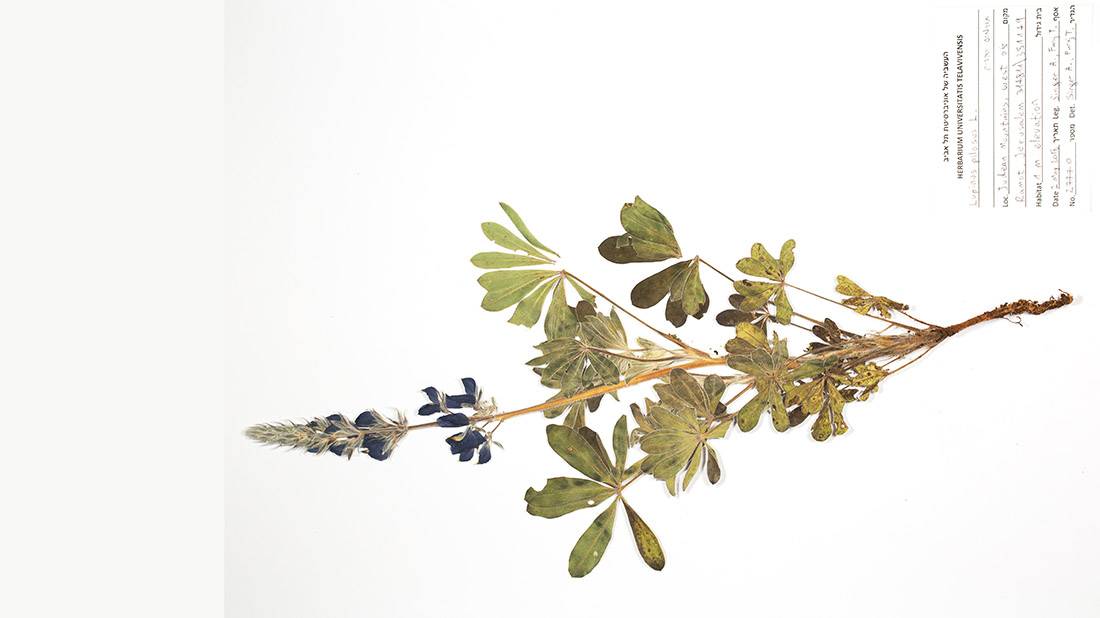
The land plant herbarium at the Steinhardt Museum of Natural history is a collection of dry plant specimens, which serves as a source of information on plants growing in terrestrial habitats. It comprises two sections: a plant collection of vascular plants and mosses, and a collection of lichens. The specimens are generally pressed plants, which are mounted on paper sheets, labeled and kept in files. The specimens are stored on shelves organized in an alphabetical order according to the scientific names of plant families and genera and species. The collection contains a wide representation of the flora of Israel, Jordan and Sinai, as well as numerous specimens collected worldwide.
The lichen collection
The lichen collection was established in 1965, when Israel Reichert, who had studied lichens since 1936, donated his collection and large library to the Department of Plant Sciences at Tel Aviv University. This donation comprised some 2000 specimens from many countries, and a collection of largely unidentified lichens collected in Israel, Sinai and several neighboring countries.
The lichen collection from abroad, which contains to date some 4000 specimens, served as reference material for the preparation of the The Lichens of Israel by Margalit Galun (1970), published by the Israel Academy of Sciences and Humanities, and for later studies on the lichen flora of Israel and Sinai. All the species (about 300, several specimens of each) described in these studies form the lichen herbarium of the local species (Israel and Sinai).
The Vascular Plant Herbarium
The herbarium of vascular plants of the Tel Aviv University was originally established by Dov Talisman and Lea Prusbul in the 1950s, representing the flora of Israel. During 30 years of activity, it grew to be a rich collection, well representing the natural plant diversity of Israel. A major part of the herbarium was collected by Rivka Dulberger in the 1960s becoming the second largest collection of land plants of Israel. Three decades ago, discontinuing staff situation resulted that a large part of the vascular plants herbarium was transferred to HUJ herbarium of the Hebrew University in Jerusalem.
In 2018, with the opening of the Steinhardt Museum, Dr. Yuval Sapir and Dr. Jotham Ziffer-Berger relaunched the initiative of establishing an active botanical collection which would support the scientific needs of botanists and cover our region’s biodiversity.
The renewed land plant herbarium was inaugurated in 2018, and it is growing rapidly. The herbarium staff regularly collects plants for the herbarium and accepts donations of plant specimens from amateur botanists. Major goal of the herbarium is to facilitate taxonomic, evolutionary and ecological research projects. Our collection contains ca. 2500 specimens of land plants, mainly flowering plants, but also seeks to expand the collection of non-flowering plants such as mosses, liverworts and ferns. The land plant herbarium also serves a reference collection to the University Botanic Garden living plant collection, as well as to the museum’s Archaeobotanical collection.
Herbaria of Marine and freshwater plants
Herbaria of marine and freshwater plants (seaweeds, Charophytes, Bryophytes and vascular plants including seagrasses and freshwater plants), and collections of Cyanobacteria and aquatic parasitic fungi.
The herbaria and collections store ca. 30,000 specimens, representing approximately 1000 species. The vast majority are samples of seaweeds and seagrasses from the following phyla: Rhodophyta, Chlorophyta, Ochrophyta and Tracheophyta (Order Alismatales). Most specimens originate from the Mediterranean and Red Sea waters of Israel and Sinai. There is also an extensive collection of specimens from Australia, Africa, America and other locations.
The collections were founded by the late Dr. Yaacov Lipkin, one of the early pioneers to study the algae and seagrasses of the Israel’s coasts in the early 1960s. He collected most of the specimens and also included other collections of other Israeli Phycologists.
Among our unique specimens there are two holotypes of parasitic fungi collected from Sinai: one developed inside the rhizome of the common seagrass Halophila stipulacea and the other on the soot of the mangrove tree Avicennia marina. Additionally, there are three holotypes of seaweeds collected by Lipkin, from Eritrea and Sinai, one holotype (Calliblepharis rammediorum) and one isotype (Codium pulvinatum) of seaweed collected and described from the shores of Israel by Dr. Hoffman. Dozens of new species collected by Lipkin and Hoffman from Eilat, Sinai and the Levantine shore, will be described and published soon.
The herbarium of seaweeds keeps the oldest specimens found at the Steinhardt Museum of Natural History. These specimens of Sargassum were collected from Beirut, Lebanon, back in 1880 and 1892.
The fungi herbarium
The fungi herbarium is a comprehensive collection consisting mainly of mushrooms from Israel and the East-Mediterranean region. It is a unique collection that was founded by mycologist Nissan Binyamini in the 1960s, and continuous until 1992. His collection comprises approximately 6000 specimens among which 260 genera. It serves as the paramount referential work on fungi of Israel.
During 2016 – 2025 Bruria Gal added 1,500 new specimens, among which 150 genera of gilled and non-gilled mushrooms. These were collected mainly in the Judean hills around Jerusalem, the Carmel mountain near Haifa, as well as the Galil and Golan regions. In rainy seasons, unique species were collected in the Negev desert.
The collection comprises approximately 7,500 specimens of fungi, conserved in paper envelopes under required conservation conditions. The collection encompasses species of ascomycetes, basidiomycetes mushrooms and slime molds, making it the largest mushroom collection of the Middle East.
The herbarium is listed in Index Herbariorum under the acronym TELA.
To support the morphological identification of the specimens, DNA was extracted, amplified using ITS1 and ITS4 and sequences were identified by performing a search against the nucleotide collection in GenBank. Sequences were submitted to GenBank.
The fungi collection seeks further development and welcomes exchange and donations by both scientists and amateurs, who are all welcome to visit and contribute to this increasing body of knowledge. Visits to the fungi collection can be scheduled with the herbarium staff.
Staff members
Curator
Dr. Yuval Sapir, Section Leader
Associate curator
Dr. Jotham Ziffer Berger
Collection managers
Dr. Razy Hoffman – Herbaria of marine and freshwater plants, Cyanobacteria and aquatic parasitic fungi
Dr. Jotham Ziffer Berger – Land plant herbarium
Yonatan Gur – Fungi
Bruria Gal – Fungi
Shira Penner – Herbarium
Yarden Kirshenbaum – Technical Assistant
Volunteers
Miri Lazar
Yacov Ashani